 PassPathways
Last checked: November 17, 2026.
Course details change, and your course materials come first. This guide uses the WGU Institutional Catalog (October 2026). Your course page, simulation instructions, and rubric always override it.
C216 MBA Capstone is the 4-competency-unit final course in WGU’s MBA. WGU’s catalog says you launch a new business from the ground up as an entrepreneur in a business simulation, then develop your personal brand and plan your career path. Success comes from one consistent strategy, careful cash management, and a clear record of why you made each decision.
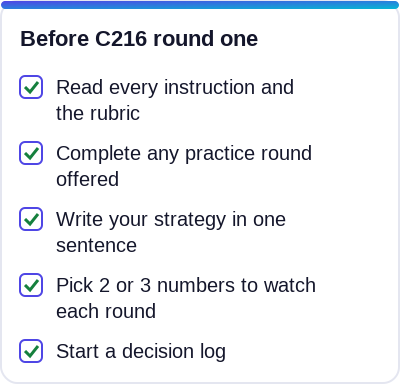
Before you make a single decision, know the rubric, practice once, state your strategy, and decide which numbers you’ll track in a log.
What does C216 ask you to do?
From the October 2026 catalog:
| Course | C216 MBA Capstone |
| Competency units | 4 |
| Position | The final course in the MBA |
| Main tasks | Launch a business in a simulation, develop a personal brand, and plan your career path |
| Transfer | WGU’s MBA transfer guideline on partners.wgu.edu lists C216 as non-transferable (that page is labeled Catalog 03-2014) |
The catalog doesn’t name the simulation software or describe its rounds. Follow your course instructions for the platform, number of rounds, and how your results and write-ups are graded.
Before round one: a setup checklist
- Read every simulation instruction and the rubric before making a decision.
- Complete any practice round the course offers.
- Write down your strategy in one sentence: who you serve, and why they’d choose you.
- Set two or three numbers you’ll watch every round, such as cash, market share, and profit.
- Start a decision log (template below).
How should you think about each round?
| Area | Question to ask | Data to check first |
|---|---|---|
| Strategy | Am I still competing on low cost or on differentiation? | My positioning compared with competitors |
| Demand | How many units will customers likely buy at my price? | Last round’s sales, market size, and competitor prices |
| Production | Can I meet that demand without piling up inventory? | Inventory on hand and production capacity |
| Cash | Will I have enough cash through the end of the round? | Cash balance, loans, and planned spending |
| Pricing | Does my price fit my strategy and cover my costs? | Unit costs and competitor pricing |
| Review | What did last round’s change actually do? | My decision log |
Change a few things at a time. If you move price, production, and marketing all at once, you won’t know which one worked.
Worked example: break-even and cash
These numbers are made up to show the math. They don’t come from WGU’s simulation.
Say your product sells for $50, each unit costs $30 to make, and fixed costs are $40,000 per round.
- Contribution per unit: $50 − $30 = $20.
- Break-even volume: $40,000 ÷ $20 = 2,000 units per round.
- At 2,500 units sold, profit is (2,500 × $20) − $40,000 = $10,000.
- At 1,500 units, the loss is $10,000.
Now cash. You start the round with $25,000, plan to produce 3,000 units ($90,000), and expect $100,000 in sales. If customers pay at the end of the round, you face $130,000 in costs ($90,000 production plus $40,000 fixed) with only $25,000 on hand. That’s a $105,000 gap to cover with a loan or smaller production. Profit on paper doesn’t pay bills during the round. Check how your simulation handles timing.
Keep a decision log
A simple table, one row per round, keeps your reasoning visible and helps with any written reflection your course requires:
| Round | Decision | Why | Expected result | Actual result | Lesson |
|---|---|---|---|---|---|
| 1 |
Fill in “Why” and “Expected result” before you submit the round, not after.
The personal brand and career plan
The catalog pairs the simulation with your personal brand and career path. Plan, rather than write, using these steps, then follow your task directions:
- List three strengths with evidence from your MBA courses or work.
- Name the role or direction you’re aiming for in three to five years.
- Identify the gaps: skills, experience, or credentials between you and that role.
- Set steps with dates for closing each gap.
- Check every rubric aspect and make sure your plan addresses it.
Common mistakes
- Switching strategy every round after one bad result.
- Chasing market share while cash runs out.
- Overproducing “just in case” and tying up cash in inventory.
- Making decisions with no record of the reasoning.
- Writing a generic career plan with no specific steps or evidence.
When to get help
- A round goes badly: talk to your Course Instructor about what to learn from it, rather than guessing.
- The rubric is unclear: ask your instructor what a specific aspect means.
- You need structure or accountability: coaching can help you plan and review your own decisions. The decisions and writing stay yours.
See getting moving again when a capstone stalls and capstone structure examples. The simulation draws on earlier courses, including C214 Financial Management and C213 Accounting for Decision Makers.
Feeling stuck between rounds or unsure what your instructor’s feedback means? Capstone coaching can help you plan your next round and review your reasoning. You make every decision yourself. Ask about coaching.
WGU C216 MBA Capstone FAQ
What simulation does the WGU MBA capstone use? WGU’s catalog doesn’t name it. Check your course page and instructions.
Can C216 transfer in from another school? WGU’s MBA transfer guideline lists it as non-transferable.
How many competency units is C216? Four, according to the October 2026 catalog.
Can someone run the simulation for me? No. The simulation and the written work must be your own. A coach can teach strategy and explain feedback.
Related guides
PassPathways is an independent resource and is not affiliated with WGU or any simulation provider. This guide contains original advice. Always submit your own work.
Stuck on your capstone? Get a plan for your next milestone.
Tell us what you want, and we'll reply with how a tutor can help. We teach and coach. When you're ready, agree to our terms below.
Get startedWant help with your WGU course?
Reading a guide is a great start, but some topics click faster when someone explains them to you. Our tutors work one on one with WGU students.
- Tell us where you're stuck. Share your course and what feels hard.
- We reply on WhatsApp or email. No forms to wait on if you'd rather chat.
- A tutor explains it and builds a plan with you, so you understand the material and pass on your own.
- Original guides, fact-checked against official WGU sources
- Honest, ethical tutoring: we teach, you do your own work
- Free practice quizzes to check your progress