 PassPathways
Last checked: November 17, 2026.
Exam outlines change. Each plan follows the topic weights on College Board’s exam pages, linked from our exam guides. Check the current outline on College Board’s CLEP site before you start.
A good CLEP study plan spends the most time on the topics that carry the most weight on College Board’s outline. Below are suggested 2-week and 4-week plans for each exam we have a guide for. The 2-week plan suits a subject you mostly know, and the 4-week plan suits one you need to relearn.
These plans are suggestions from PassPathways, not College Board guidance. Adjust them to your schedule and your weak topics.
This page is for students who have chosen a CLEP exam and want a day-by-day or week-by-week schedule to follow. Choose your plan length honestly. The 2-week plan assumes you’ve studied the subject before and mostly need review. The 4-week plan assumes you’re relearning it, or meeting parts of it for the first time. If you’re unsure, take the matching practice quiz cold first. A low score points to the 4-week plan. Before you start, make sure the exam actually counts for your degree, and read its study guide so you know what each topic covers. If your test date is already booked and close, use the 2-week structure but cut the review days, not the practice.
Start here if your exam is soon
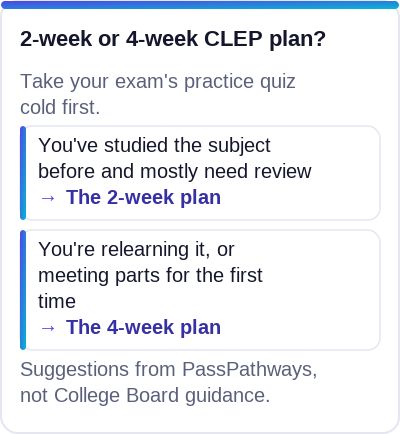
Your cold quiz score decides the plan: review needs two weeks, relearning needs four.
- Take the practice quiz cold for your exam, from the list below.
- Pick the 2-week or 4-week plan based on that score.
- Book or move your test date so the last few days are for timed practice, not new material.
Plans on this page
- CLEP College Algebra: weighted toward functions, with algebraic operations and equations close behind. Pairs with the College Algebra guide.
- CLEP Precalculus: functions first, then trigonometry, which appears across the exam. Pairs with the Precalculus guide.
- CLEP Calculus: limits, then derivatives (half the exam), then integrals, since each builds on the last. Pairs with the Calculus guide.
- CLEP Chemistry: structure and states of matter first, then reactions and calculations. Pairs with the Chemistry guide.
- CLEP Biology: molecular, organismal, and population biology in roughly equal parts. Pairs with the Biology guide.
- CLEP Financial Accounting: the accounting equation and balance sheet first, then income and cash flow statements. Pairs with the Financial Accounting guide.
How do these plans work?
- Each plan starts with a cold practice quiz, so you know where you stand.
- Topics are ordered by weight on College Board’s outline, biggest first, unless one builds on another.
- The last days are for timed, mixed practice and review, not new material.
- A score of 90% or more on our quiz is a good sign to move on to timed practice. It isn’t a prediction of your CLEP score.
For general study habits, read how to study for CLEP.
CLEP College Algebra
Read the College Algebra guide first.
2-week plan
- Days 1 to 2: Take our practice quiz cold, read the official outline, and mark each topic as solid, shaky, or weak.
- Days 3 to 5: Functions and their properties (30%): domain and range, combining functions, graphs, transformations, and inverses.
- Days 6 to 7: Algebraic operations (25%): exponents, factoring, polynomials, absolute value, and log properties.
- Days 8 to 9: Equations and inequalities (25%): linear, quadratic, absolute value, systems, and exponential and log equations.
- Days 10 to 11: Number systems (20%): complex numbers, factorials, and the binomial theorem.
- Days 12 to 13: Timed mixed practice. Review every miss and redo it a day later.
- Day 14: Retake the practice quiz, review lightly, and rest.
4-week plan
- Week 1: Take our practice quiz cold, read the official outline, and mark each topic as solid, shaky, or weak. Then rebuild algebraic operations, especially exponents, factoring, and logs.
- Week 2: Equations and inequalities, including systems and exponential and log equations.
- Week 3: Functions: domain, range, combining functions, transformations, inverses, and graph features.
- Week 4: Number systems early in the week, then timed mixed practice. Retake the quiz until you reach 90%.
CLEP Precalculus
Read the Precalculus guide first.
2-week plan
- Days 1 to 2: Take our practice quiz cold, read the official outline, and mark each topic as solid, shaky, or weak.
- Days 3 to 5: Functions and their representations (45% together): reading graphs and tables, transformations, inverses, and the function families.
- Days 6 to 8: Trigonometry: the unit circle, identities, inverse trig, and trig equations. Trig shows up across the exam.
- Days 9 to 10: Equations and inequalities (20%), including log, rational, and radical equations.
- Day 11: Analytic geometry (10%) and functions as models (10%).
- Days 12 to 13: Timed practice: one block with a graphing calculator and one without.
- Day 14: Retake the practice quiz, review lightly, and rest.
4-week plan
- Week 1: Take our practice quiz cold, read the official outline, and mark each topic as solid, shaky, or weak. Then review algebra skills and the main function families.
- Week 2: Function representations and transformations, plus inverses and combining functions.
- Week 3: Trigonometry in depth, then analytic geometry.
- Week 4: Functions as models, practice with the calculator tools, and timed mixed sets. Retake the quiz until you reach 90%.
CLEP Calculus
Read the Calculus guide first.
2-week plan
- Days 1 to 2: Take our practice quiz cold, read the official outline, and mark each topic as solid, shaky, or weak. Patch any weak algebra or trig skills.
- Days 3 to 4: Limits (10%): properties, limits at infinity, continuity, and L’Hospital’s Rule.
- Days 5 to 8: Derivatives (50%): the rules, chain rule, implicit differentiation, and applications like extrema, motion, and related rates.
- Days 9 to 11: Integrals (40%): antiderivatives, substitution, the Fundamental Theorem, area, and average value.
- Days 12 to 13: Timed practice: one block without a calculator and one with a graphing calculator.
- Day 14: Retake the practice quiz, review lightly, and rest.
4-week plan
- Week 1: Take our practice quiz cold, read the official outline, and mark each topic as solid, shaky, or weak. Then review algebra and trig, and study limits and continuity.
- Week 2: Derivative rules, the chain rule, implicit differentiation, and higher derivatives.
- Week 3: Applications of derivatives, then antiderivatives and substitution.
- Week 4: Definite integrals, their applications, and growth and decay, then timed mixed practice. Retake the quiz until you reach 90%.
CLEP Chemistry
Read the Chemistry guide first.
2-week plan
- Days 1 to 2: Take our practice quiz cold, read the official outline, and mark each topic as solid, shaky, or weak.
- Days 3 to 4: Structure of matter (20%): atoms, isotopes, electrons, periodic trends, bonding, and shapes.
- Days 5 to 6: States of matter (19%): gas laws, kinetic theory, phase diagrams, and solutions.
- Days 7 to 8: Reaction types (12%) and stoichiometry (10%): acid-base, precipitation, redox, balancing, and moles.
- Days 9 to 10: Descriptive (14%) and experimental chemistry (9%).
- Day 11: Equilibrium (7%), kinetics (4%), and thermodynamics (5%).
- Days 12 to 13: Timed mixed practice, using the periodic table and calculator.
- Day 14: Retake the practice quiz, review lightly, and rest.
4-week plan
- Week 1: Take our practice quiz cold, read the official outline, and mark each topic as solid, shaky, or weak. Then study structure of matter.
- Week 2: States of matter, plus daily mole and stoichiometry practice.
- Week 3: Reaction types, equilibrium, pH, kinetics, and thermodynamics.
- Week 4: Descriptive and experimental chemistry, then timed mixed practice. Retake the quiz until you reach 90%.
CLEP Biology
Read the Biology guide first.
2-week plan
- Days 1 to 2: Take our practice quiz cold, read the official outline, and mark each topic as solid, shaky, or weak.
- Days 3 to 6: Molecular and cellular biology (33%): chemistry of life, cells, enzymes, respiration, photosynthesis, cell division, DNA, and protein synthesis.
- Days 7 to 9: Organismal biology (34%): plants, animal systems, homeostasis, development, and heredity, with daily genetics problems.
- Days 10 to 12: Population biology (33%): ecology, evolution, classification, behavior, and human impact.
- Day 13: A timed mixed set, keeping to under a minute per question.
- Day 14: Retake the practice quiz, review your flashcards, and rest.
4-week plan
- Week 1: Take our practice quiz cold, read the official outline, and mark each topic as solid, shaky, or weak. Then study molecular and cellular biology.
- Week 2: Organismal biology, with genetics practice every day.
- Week 3: Population biology: ecology, evolution, and behavior.
- Week 4: Flashcard review of all three areas, then timed mixed practice. Retake the quiz until you reach 90%.
CLEP Financial Accounting
Read the Financial Accounting guide first.
2-week plan
- Days 1 to 2: Take our practice quiz cold, read the official outline, and mark each topic as solid, shaky, or weak.
- Days 3 to 5: General topics (20% to 30%): the accounting equation, debits and credits, the accounting cycle, and principles.
- Days 6 to 9: The balance sheet (30% to 40%): cash, receivables, inventory, depreciation, liabilities, bonds, and equity.
- Days 10 to 11: The income statement (20% to 30%) and the statement of cash flows (5% to 10%).
- Days 12 to 13: Timed mixed practice with numbers. Redo every miss.
- Day 14: Retake the practice quiz, review lightly, and rest.
4-week plan
- Week 1: Take our practice quiz cold, read the official outline, and mark each topic as solid, shaky, or weak. Then drill the accounting equation and journal entries.
- Week 2: The income statement, revenue recognition, and inventory methods.
- Week 3: The rest of the balance sheet: receivables, depreciation, liabilities, bonds, and equity.
- Week 4: The statement of cash flows and ratios, then timed mixed practice. Retake the quiz until you reach 90%.
CLEP study plan FAQ
How long should I study for a CLEP exam? It depends on what you already know. Use the cold quiz to decide between the 2-week and 4-week plans.
How many hours a day should I study? There’s no official number. Pick a daily amount you can keep up, and build in review.
What if I run out of time? Move your test date if you can. A retake means a three-month wait, so it’s worth being ready. See CLEP retakes.
Related
PassPathways is an independent resource and is not affiliated with College Board, Modern States, WGU, Sophia, or Study.com. CLEP is a registered trademark of College Board.
Stuck on this course? Get one-on-one tutoring.
Tell us what you want, and we'll reply with how a tutor can help. We teach and coach. When you're ready, agree to our terms below.
Get started